Sunday, October 27, 2013
SV#4: Unit I Concept 2: Graphing logarithmic functions and identifying x-intercepts, y-intercepts, asymptote, domain, range
The viewer needs to pay attention to how the asymptote is found. For this function, x=h, so you need to look for h to find the asymptote. The viewer must also pay attention to how to do the change of base formula to find the y- intercept. The viewer must know how to put these numbers into the calculator. To find the x-intercept, the viewer must know how to exponentiate. Also, they must pick key points that are to the right of the asymptote. Another thing to pay attention to is that the range is always all real numbers and the domain depends on the asymptote.

SP#3: Unit I Concept 1: Graphing exponential functions and identifying x-intercept, y-intercept, asymptotes, domain, and range

Sunday, October 20, 2013
SV#3: Unit H Concept 7: Finding logs with given approximations
The viewer needs to pay special attention to a couple of things. The viewer should pay attention to the clues given to them because this can make them solve the problem faster. It can be solved faster because many times, the numbers you can simplify with are given. The viewer must also pay attention to the base because the base can possibly give them clues. The viewer must also pay attention to the letters given in the clues. These letters are the last step to the problem, so they are very important.
Monday, October 7, 2013
SV #2: Unit G Concept #1-7: Rational Functions
This problem shows you how to find a rational function when the degree on top is bigger than the degree on bottom. This means that it is a slant asymptote and this means that there is no horizontal asymptote. This problem consists of various steps that are all explained in the video above. To graph this, we must find the x and y intercepts, the domain, and a couple of points to help us plot our lines into the graph. This example contains a numerator with a degree of three, a denominator with a degree of two, one vertical asymptote, one hole, and two x-intercepts.
In this problem, we must focus on the degrees of the beginning of the problem. This is important because this tells us what asymptote it is. When there is a slant asymptote, there is no horizontal assymptote and when there is a horizontal, there is no slant. To find a slant asymptote, we need to use long division. The remainder does not matter in this case. The equation you get is for the line that goes on the graph. The viewer must also pay close attention to finding the correct vertical asymptote. If it is done correctly, then it makes you a step closer in having a correct graph. The viewer must also pay attention to the holes the problem has. The viewer must plot points correctly on the graph (x/y inercepts., holes).
Sunday, September 29, 2013
SV #1: Unit 7 Concept 10: Finding all zeroes (real & complex)
This problem is about solving for the zeroes and finding the factorization of -22x^4-167x^3-103x^2+47x +5. For this problem, you have to find the p's and q's which is the possible real/rational zeroes. Then, you need to find the possible positive/negative real zeroes using Decartes Rule of Signs. Then, you must use synthetic division and plug in numbers form your p/q list. Once you have a quadratic, you can factor or use the quadratic formula to solve and get your final zeroes.
The viewer must pay special attention a couple of things. The viewer must pay attention to finding the possible real/rational zeroes. This way, the viewer eliminates many numbers that they can plug in while doing the synthetic division, The viewer must also pay attention to finding the possible positive/negative real zeroes. This involves Decartes Rule of Signs and if you do this right, then you can eliminate some numbers from your p/q list. The viewer must also pay attention to distributing negatives properly while doing the quadratic formula. This makes is easier for the viewer to do their work.
Monday, September 16, 2013
SP #2: Unit E Concept 7: Graphing Polynomials, uncluding: x-int, y-int, zeroes (with multiplicities), end behavior.
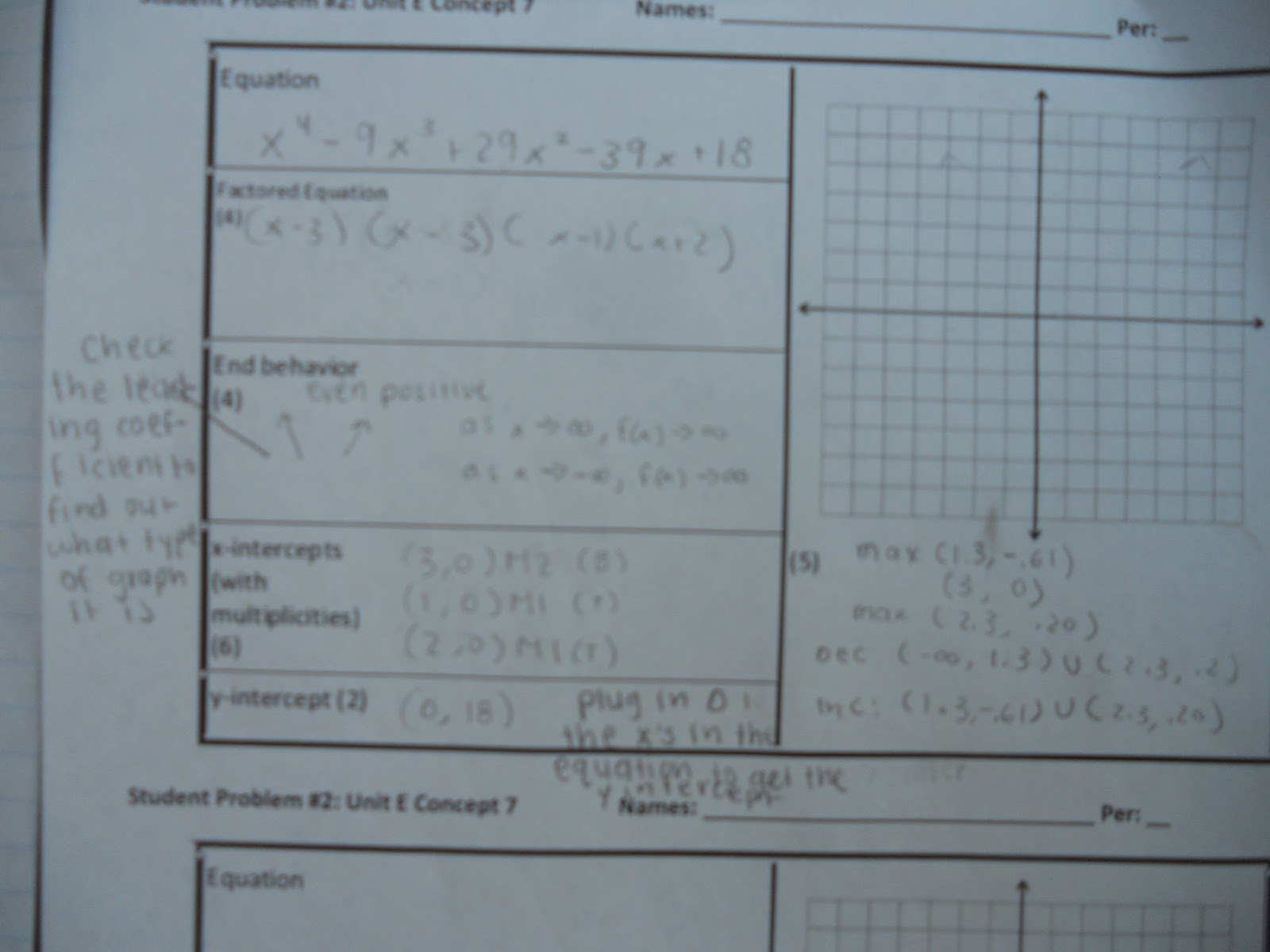


This problem is about solving a polynomial with a fourth degree and then graphing it. To find the x-intercepts, you must factor the polynomial. From here, you can find the multiplicities of it. Once knowing what the multiplicities are, then you will know if it will go through, bounce, or curve.
The viewer needs to pay special attention to the leading coefficient. This is the key to finding out how the graph will look like. The viewer must also pay attention to the multiplicities. The multiplicities will say if it goes through, bounce, or curves.
Wednesday, September 11, 2013
Subscribe to:
Posts (Atom)